EnvelopeDock
OEM · Wholesale · Factory Direct
Custom Envelope Manufacturing — Complete OEM Production
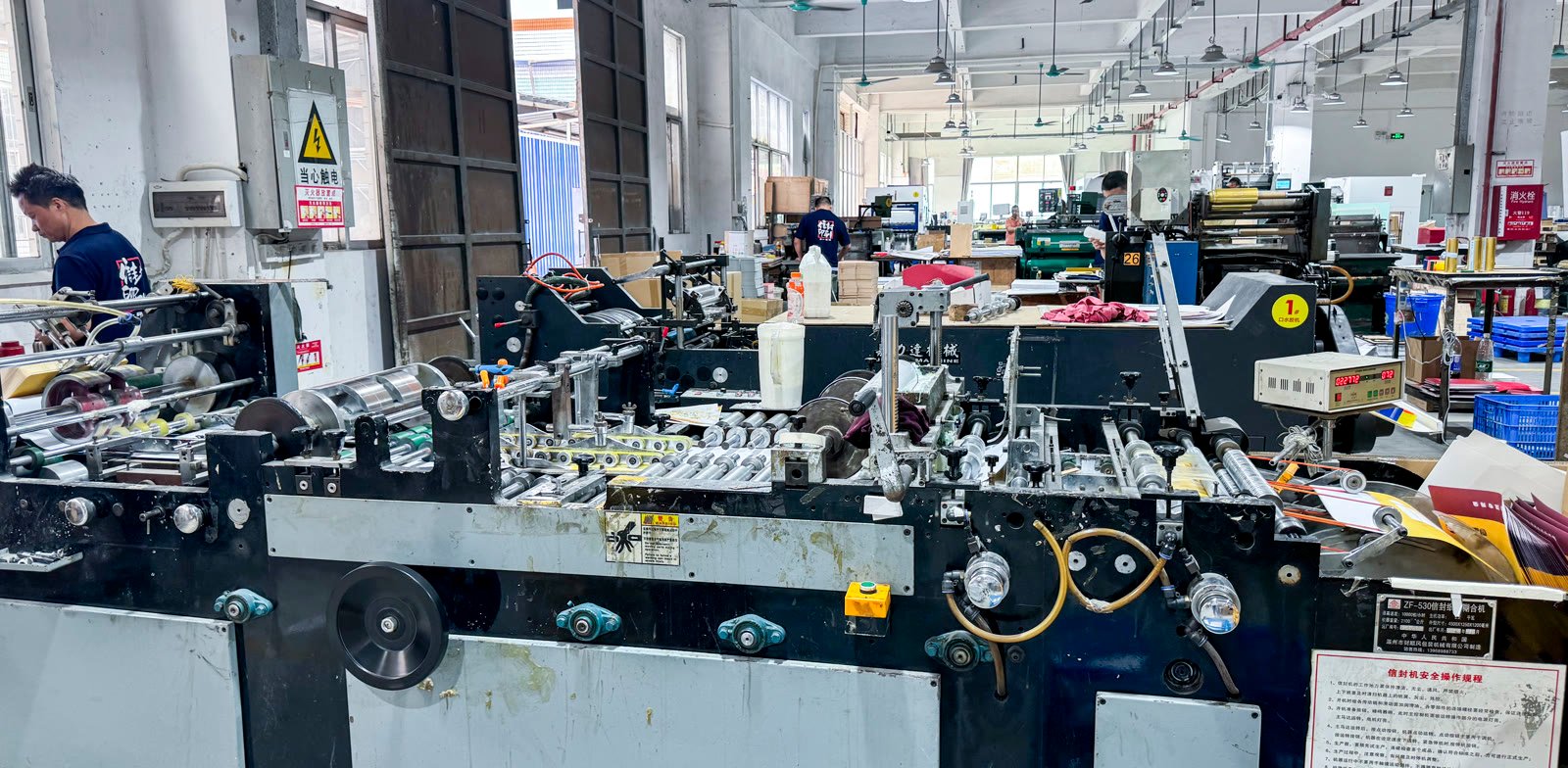
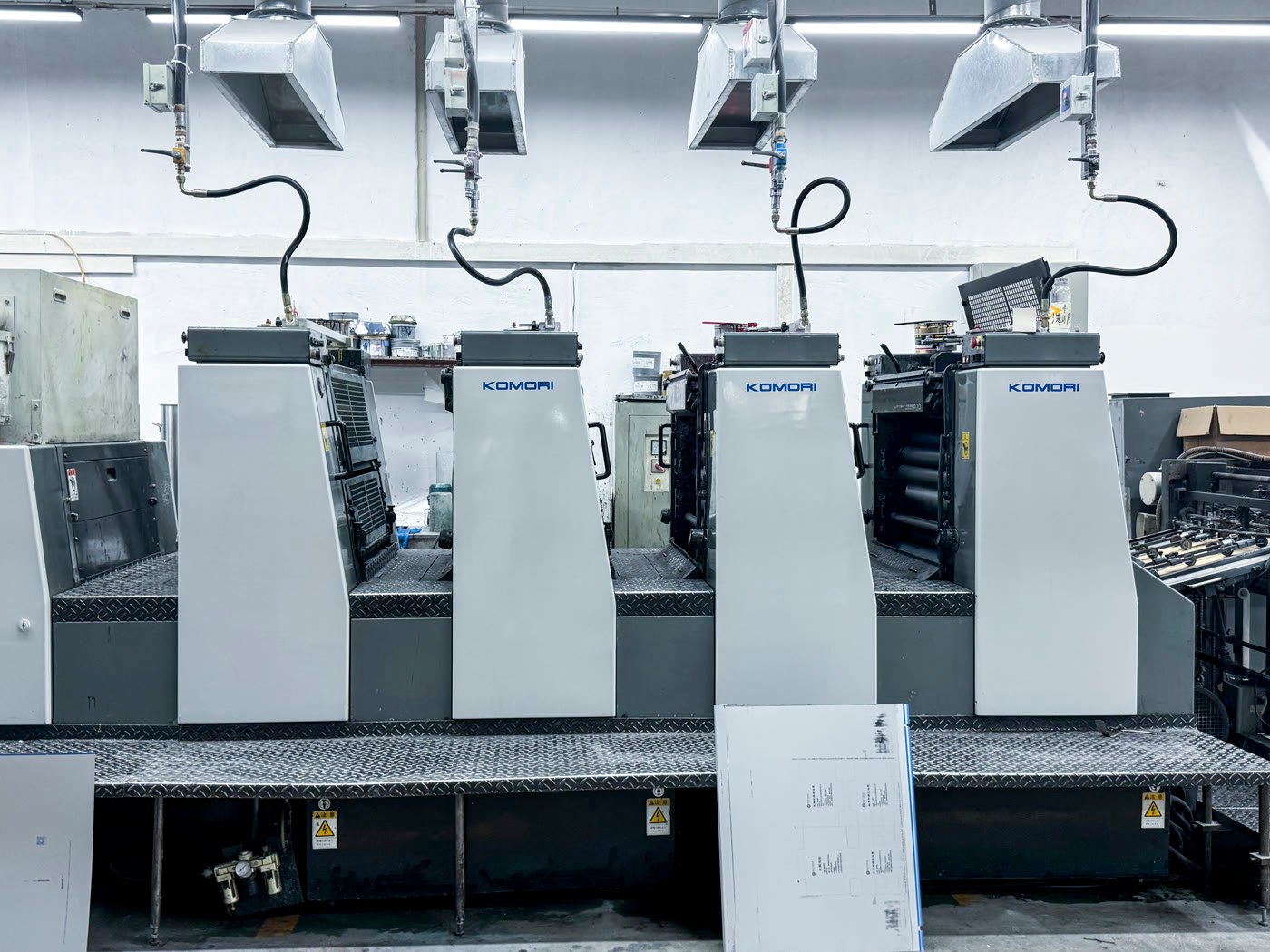
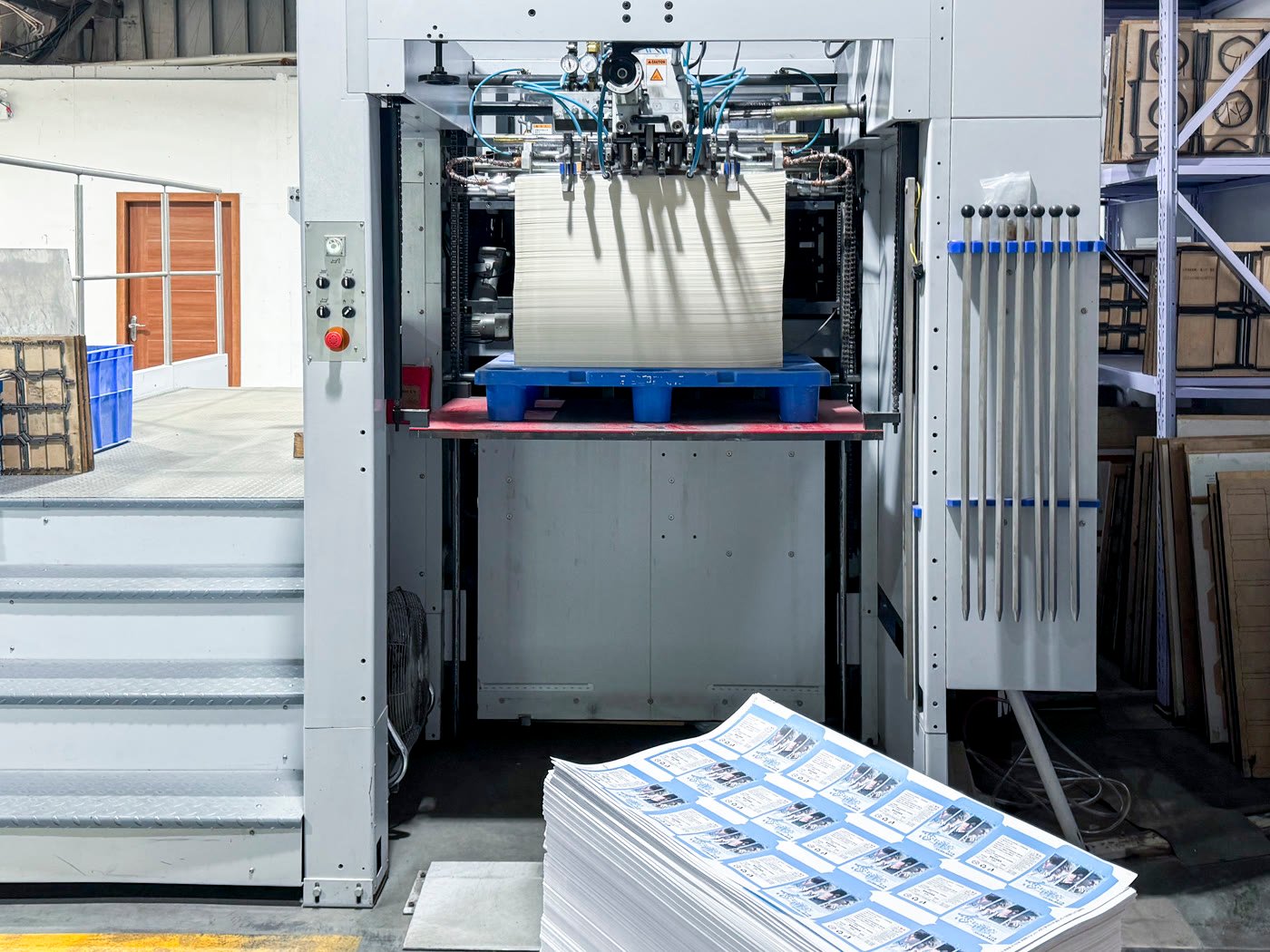
OEM envelope manufacturing here covers the whole chain in one plant in Guangdong: die making, digital or offset printing, window patching, foil stamping and emboss, lamination and folding. Nothing is subcontracted to an outside die shop or trade printer, so colour targets and dimensions repeat on reorders. Custom sizes need a new cutting die from 2,000 pieces; standard sizes with custom printing start at 1,000, and specialty finishes at 500. Artwork is CMYK at 300 dpi with 2–3 mm bleed.
Everything you need to know about custom envelope manufacturing. From paper selection and sizing to printing techniques and closure options — this is your guide to producing envelopes that match your exact specifications.
How Custom Envelope Manufacturing Works
Custom envelope manufacturing is a multi-stage process that transforms raw paper stock into precisely specified envelopes. Unlike off-the-shelf products, every variable — size, paper, printing, closure, window placement — is defined by your requirements.
1. Specification & Quote
You share your requirements. We provide a detailed quote within 24 hours, including unit pricing, tooling costs (if applicable), production timeline, and shipping options.
2. Design & Proof
Our team creates a digital proof showing exact dimensions, print placement, and window positioning. You review and approve — or request changes — before production begins.
3. Die Creation & Setup
Custom sizes and window shapes require a cutting die. We manufacture the die in-house, set up the envelope machines, and run a pre-production sample for your approval.
4. Production & QC
Full production runs through automated envelope-folding machines, printing presses, and window-patching stations. Inline QC checks dimensions, glue adhesion, and print registration.
5. Packaging & Shipping
Envelopes are packed in cartons (typically 500/pack), palletized, and shipped via your preferred freight method. We handle customs documentation for international orders.
Custom Envelope Sizes — Any Dimension
While we manufacture all standard envelope sizes — from A2 greeting card envelopes to 10×13" catalog mailers — our specialty is custom dimensions built to your exact specification. There is no "standard" we can't deviate from.
| Category | Common Sizes | Typical Use | Custom Range |
|---|---|---|---|
| Business (#10 family) | #10 (4⅛×9½"), #9 (3⅞×8⅞"), #6¾ (3⅝×6½") | Invoices, statements, correspondence | 3×5" to 5×10" |
| Announcement (A-series) | A2 (4⅜×5¾"), A6 (4¾×6½"), A7 (5¼×7¼"), A9 (5¾×8¾") | Invitations, greeting cards, RSVPs | 3×4" to 6×9" |
| Catalog / Booklet | 6×9", 9×12", 10×13" | Catalogs, brochures, legal docs | 5×7" to 12×15" |
| Square | 5×5", 5½×5½", 6×6", 7×7" | Events, parties, special occasions | 3×3" to 10×10" |
| Coin / Remittance | #1–#7 (various) | Donation envelopes, payment remittance | 2½×4" to 4×7" |
| Fully Custom | Any dimension | Unique packaging, specialty inserts | As specified |
📐 See our interactive envelope size guide for a visual comparison of all standard sizes. Need a size not listed? Contact us with your dimensions.
Envelope Paper Types & Weight — How to Choose
The paper you choose affects how your envelope looks, feels, prints, and performs in mailing equipment. From 24lb white wove to 40lb kraft, understanding envelope paper types and weights ensures your custom envelopes meet both aesthetic and functional requirements.
| Paper Type | Weight Range | Characteristics | Best For |
|---|---|---|---|
| White Wove | 20lb – 28lb | Smooth, bright white, standard finish | Everyday business mail, #10 envelopes |
| Premium Smooth | 24lb – 32lb | Extra-smooth surface, excellent print quality | Logo printing, premium correspondence |
| Kraft Paper | 28lb – 40lb | Natural brown, recycled content, rustic texture | Eco-friendly brands, shipping mailers |
| Recycled / FSC | 24lb – 28lb | Post-consumer or FSC-certified fiber | Sustainability-focused organizations |
| Colored Stock | 24lb – 28lb | 30+ colors available, dyed through | Brand color matching, events |
| Tyvek® | 14lb – 18lb | Water, tear & puncture resistant | Shipping, medical, legal documents |
| Specialty / Textured | Varies | Linen, laid, felt, metallic, vellum | Luxury brands, special occasions |
Custom Envelope Printing — Offset, Digital & Logo
Your custom envelope printing options range from one-color logo printing to full-bleed CMYK designs. The right method depends on your design complexity, order quantity, and budget — we'll help you choose.
Offset — Spot Color (1-2 colors)
Pantone-matched ink for logos, return addresses, and simple brand marks. Most cost-effective for large quantities. Crisp, consistent results.
Offset — Full Color (CMYK)
Four-color process for photographs, complex artwork, and rich brand designs. Full-bleed printing available — color edge-to-edge on the envelope face.
Digital Printing
No plates required. Ideal for short runs, variable data (unique addresses per envelope), and personalized mailings. Faster setup, higher per-unit cost.
Inside Printing
Print patterns, security tints, or messaging on the inside of the envelope. Commonly used for security envelopes and premium brand experiences.
Envelope Finishes — Foil Stamping, Embossing & UV
Beyond printing, custom envelope finishes add tactile and visual distinction. Foil stamping, embossing, spot UV, and lamination — each can be combined to create a unique envelope that elevates your brand.
| Finish | Process | Effect | Best For |
|---|---|---|---|
| Foil Stamping | Heat + pressure transfers metallic foil onto paper | Gold, silver, copper, holographic shine | Luxury brands, wedding invitations, premium logos |
| Embossing / Debossing | Raised (emboss) or recessed (deboss) design pressed into paper | 3D tactile texture | Logos, monograms, premium stationery |
| Spot UV | Glossy clear coating applied to specific areas | High-shine contrast against matte paper | Logo highlights, design accents |
| Matte / Gloss Lamination | Thin plastic film bonded to paper surface | Durable, water-resistant finish | High-wear applications, shipping envelopes |
Envelope Closure Types — Peel & Seal, Gummed & Self-Seal
Choosing the right envelope closure type affects how recipients open your mail, how envelopes perform in automated mailing equipment, and how quickly your team processes outgoing correspondence.
Gummed (Traditional)
Water-activated adhesive on the flap. Most economical choice. Requires moisture to seal — ideal for low-volume manual mailing.
Peel & Stick
Removable strip covers pre-applied adhesive. No moisture needed. Fast, clean, and sanitary. Our most popular closure for business envelopes.
Self-Seal (Latex)
Two strips of latex adhesive on flap and body — press together to seal. Strong bond, long shelf life. Excellent for high-volume mailers.
String & Button
Traditional closure with a string wrapped around a button disc. Reusable, distinctive. Common for inter-office envelopes and specialty folders.
Custom Window Envelopes — Die-Cut Windows & Positioning
A custom window envelope does more than show an address. It's a functional design element that must align precisely with your printed document inside. We manufacture windows in any size, position, and quantity — single, double, or custom configurations.
| Window Type | Description | Common Use |
|---|---|---|
| Single Window | One opening showing the recipient address. Most common configuration. | Standard business mail, invoices, statements |
| Double Window | One window for recipient address, one for return address. Both visible through the envelope. | Reply envelopes, billing cycles, W-2 forms |
| Custom Position | Window placed at any coordinate on the envelope face. Die-cut to your exact specification. | Forms with unique address placement |
| Custom Shape | Non-rectangular window — rounded corners, oval, or branded shape. | Premium branding, unique mailers |
💡 Windows are covered with a clear poly or glassine film. We can also manufacture open-panel envelopes (no film) for applications where the document should be fully exposed.
Minimum Order Quantity & Production Timeline
Understanding envelope manufacturing MOQ and lead times helps you plan your order. Below are our standard minimums — contact us for flexible options on trial orders.
Standard Custom Printing
Minimum 1,000 pieces. Setup includes plate creation and machine configuration. Production time: 7–15 business days.
Custom Size / Die-Cut
Minimum 2,000 pieces. Requires custom cutting die fabrication. Production time: 10–20 business days including die creation.
Specialty Finishes
Minimum 500 pieces for foil stamping or embossing. Production time: add 3–5 business days to standard turnaround.
Rush Orders
Available on most product types. Expedited production can reduce turnaround by 30–50%. Additional rush fee applies.
📦 Need fewer than 1,000? Contact us — we offer flexible trial quantities for first-time clients. Trade accounts may qualify for lower MOQs.
OEM Envelope Manufacturing & Procurement
Most of our production is OEM: you own the specification and the brand, we manufacture to it. For a procurement team the buying process — not the product — is what needs planning, from the first RFQ through to repeat mass production.
From RFQ to Mass Production
Send a request for quote (RFQ) with four things — envelope size (or the insert's dimensions), paper stock and weight, printing requirement, and target quantity — and we return unit pricing, tooling cost where a custom die is required, and a production schedule. Proof approval comes before tooling, and mass production begins only after you sign off the proof. Standard printing runs 7–15 business days; custom die-cut work runs 10–20 business days including die creation.
Factory-Direct vs Buying Through a Trading Company
A trading company prices your order at factory cost plus its own margin, and relays your technical questions to the plant. Buying factory-direct removes that layer: manufacturer pricing with manufacturer accountability, and answers from the people running the presses. Our facility is in Guangdong, China, and we ship to clients in 30+ countries.
Evaluating an Envelope Supplier
| What to check | Why it matters | What we provide |
|---|---|---|
| Certification | Quality system and paper-sourcing claims | ISO 9001; FSC-certified and recycled stocks |
| In-house capability | Outsourced steps add lead time and quality risk | Cutting, folding, window patching, printing, finishing and packing under one roof |
| Tooling & MOQ | Decides whether a trial order is possible | 1,000 pcs standard print · 2,000 pcs custom die-cut · 500 pcs specialty finishes |
| Lead time and rush option | Whether the order lands inside your window | 7–15 business days standard; rush can reduce turnaround by 30–50% |
| Export experience | Customs, compliance and delivery risk | Clients in 30+ countries across North America, Europe, Asia-Pacific and the Middle East |
To open a procurement conversation, send your specification through the request for quote form — or see wholesale & bulk ordering if you are buying for resale.
Envelope Manufacturers, Factories & Producers — Which One Are You Buying From?
Buyers use “envelope manufacturer”, “envelope factory” and “envelope producer” almost interchangeably, yet the three can sit in very different parts of the supply chain. Before comparing quotations, it helps to know which role a supplier actually plays.
| Term you will see | What it usually means | What to verify |
|---|---|---|
| Envelope manufacturer | Converts paper into finished envelopes and sells on its own capacity | Whether cutting, folding, window patching and printing are in-house |
| Envelope factory | The physical plant; often runs OEM lines for several brands at once | Number of lines, capacity, QC process and current certifications |
| Envelope producer | Broad label that can cover a manufacturer, a converter or a trading house | Ask who owns the presses and who issues the proof |
| Custom envelope manufacturer | A manufacturer that also builds tooling for a specification | Whether die making and window patterns stay in-house |
| Custom envelope die manufacturer | A specialist that only makes cutting dies, often subcontracted by printers | If it is a separate company, it adds a hand-off to your timeline |
| Envelope printing manufacturer | A printer that also owns production rather than brokering the order | Press types available and how colour is matched across runs |
EnvelopeDock is both an envelope manufacturer and an OEM factory: die creation, offset and digital printing, window patching and finishing all happen in one plant in Guangdong. Because the specification passes between our own teams rather than between companies, there is no outside die shop to chase and no colour target to re-match at the next supplier — reorders come back the same, and bulk paper envelope runs booked alongside OEM mailer runs share the same tooling. Nothing is subcontracted, so a question about a fold, a paper or a colour comes back from the people running the press. Send the specification once and you get a factory-direct quotation with the die cost shown separately, so you can see what the tooling adds before committing to a quantity. For press details see custom envelope printing, and for tooling lead time see envelope die tooling & procurement.
Industry Specific Use Cases
We manufacture purpose-built envelopes tailored for specialized corporate and non-profit applications.
Charity Collection Envelopes
Custom donation envelopes printed with fundraising branding, gift aid declarations, and secure tear-off glue seals. Designed for safe coin and cash transport during charity drives.
Corporate Payroll Envelopes
Secure, opaque privacy tints and tamper-evident closures ensure confidentiality for payslips and HR documents. Fits standard business layouts seamlessly.
Hospitality & Retail
Branded hotel key card holders, gift card sleeves, and receipt envelopes manufactured with high-end finishes like foil stamping and embossing to elevate guest experience.
Greeting Card Envelopes & Stationery Brands
Custom card envelopes in the standard greeting-card formats — A2 (4⅜ × 5¾ in), A6 (4¾ × 6½ in) and A7 (5¼ × 7¼ in) — plus square and custom die-cut sizes. We supply card publishers, stationery brands and trade printers with unprinted stock for their own overprinting, or fully branded runs with logo printing, foil stamping and custom envelope liners. Peel-and-seal, gummed and string-and-button closures available.
Custom Envelope Manufacturing FAQ
What is the minimum order quantity for custom envelopes?
Our standard MOQ is 1,000 pieces for custom printed envelopes. For custom sizes requiring a new cutting die, the minimum is 2,000 pieces. Specialty finishes like foil stamping start at 500 pieces. Contact us for flexible trial quantities — we work with first-time clients to find a suitable starting volume.
How do I find a reliable envelope manufacturer in China?
Look for ISO certification, request production samples, verify their specialization (are they a dedicated envelope factory or a general print shop?), and check their export experience. We're happy to provide factory photos, certifications, and client references. Visit our About page to see our facility.
How does custom envelope printing cost compare to standard envelopes?
Custom printed envelopes typically add $35–$150 per 1,000 pieces from a factory-direct supplier, depending on size, paper, colour count and print method — see our custom envelope cost guide for the per-size breakdown. When you account for the branding value, the elimination of separate labeling or printing steps, and the professional impression, custom envelopes often deliver a lower total cost per mailing than blank envelopes with address labels.
Can I get custom envelopes with my company logo?
Yes — custom logo printing is one of our most requested services. We print your company logo and return address on any envelope style, in any size. Choose from 1-color spot printing or full-color CMYK. We accept vector files (AI, EPS, PDF) and high-resolution raster files (300+ DPI).
What envelope paper types and weights are available for custom manufacturing?
We stock white wove (20–28lb), premium smooth (24–32lb), kraft (28–40lb), recycled/FSC-certified, colored stock (30+ colors), Tyvek®, and specialty textured papers (linen, laid, felt, vellum). The right paper depends on your use case — we'll recommend based on your printing needs, mailing requirements, and budget. See our paper types guide for a full comparison.
How long does custom envelope production take?
Standard production time is 7–15 business days for printed envelopes. Custom sizes requiring die fabrication add 3–5 days. Rush orders are available and can reduce turnaround by 30–50%. Your quote will include an exact production timeline based on your specifications.
Can you supply blank card envelopes for our own overprinting?
Yes. Many card publishers and print shops order unprinted A2, A6 and A7 cardstock envelopes from us and overprint them in-house. Blank stock is available in the same papers, weights and closures as our printed runs, with MOQ from 1,000 pieces.
Ready to manufacture your custom envelopes?
Tell us your specifications — we'll respond with a detailed quote within 24 hours.
Related Envelope Manufacturing Guides
Explore our detailed guides on specific aspects of custom envelope production.
Custom Red Packets — Chinese New Year & Weddings
Envelope Size Guide — Standard & Custom Dimensions
Envelope Paper Types & Weight Comparison
Custom Envelope Printing — Offset vs Digital
Envelope Finishes Guide — Foil, Emboss & UV
Peel & Seal vs Gummed — Envelope Closure Types
How to Order Custom Envelopes →